



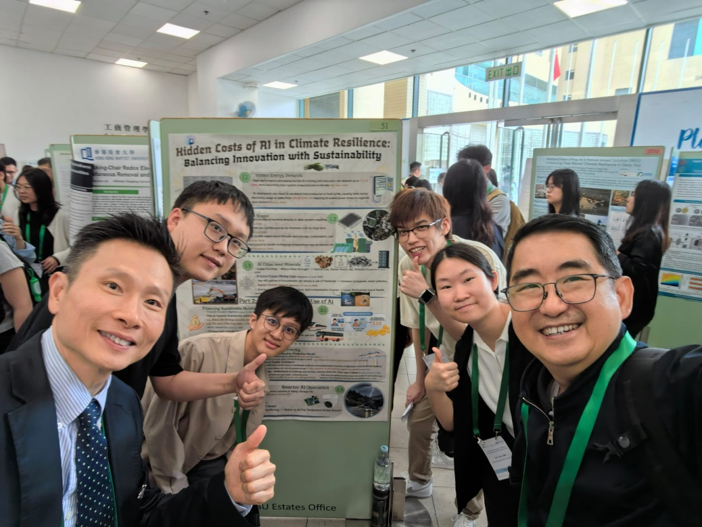

How do we protect our world from the growing shocks of climate change? At the "Empowering Tomorrow: International Symposium on Building Climate Resilience for Generations to Come," held on Friday, 12 June 2026 at the Wing Lung Bank Building (WLB) of Hong Kong Baptist University (HKBU), two talented student teams and their lecturer from the College of International Education (CIE) stepped up to share innovative answers. As part of over 400 global participants, these young researchers presented academic posters guided by Dr. Tsui Chi Keung, Martin.
Team A050: The Monetary Chains of Climate Resilience
The first group of six CIE AD students tackled global finance from their course, The Rise of the Modern Global Economy. CIE student researchers Aimen Wazir, Thihansa Godakanda, Maroof Tiaba, Naureen Saeeda, Tang Sin Ning, and Law Wing Ying analyzed the "climate-currency trap." They showed that returning to a rigid "Gold Standard" would hurt climate recovery by preventing central banks from using flexible monetary policies during disasters. Instead, they proposed using gold-backed digital currencies to maintain stability. Dr. Appiah Kubi, Lecturer at HKBU’s School of Continuing Education (SCE), visited their booth and highly praised the team for their deep historical insights.
Team A051: Hidden Costs of AI in Climate Resilience
Switching to technology, three CIE AD students—Law Tsz Yan, Lau Hok Hin Cosmas, and Cheng Pok Hang Hans—examined smart cities from their Quantitative Analysis for the Business World course. They exposed the hidden environmental costs of using Artificial Intelligence (AI) for traffic management:
- Digital Footprint: High energy demand increases carbon emissions and creates electronic waste.
- Rebound Traffic: Smoother traffic flows accidentally encourage more private car use.
- Car-Centric Planning: Focusing only on vehicle tech risks ignoring green spaces and public transit.
They urged planners to build eco-friendly digital infrastructure. Their presentation attracted great interest from Dr. Sam Lau, Director of the Research Management Office and Person-in-Charge of the Research Centre for Environment and Human Health at HKBU SCE, who praised the students highly for their strong motivation and active presentation during the symposium.
The students shared that exchanging ideas with global experts boosted their academic confidence and proved how classroom knowledge can inspire real-world climate action.
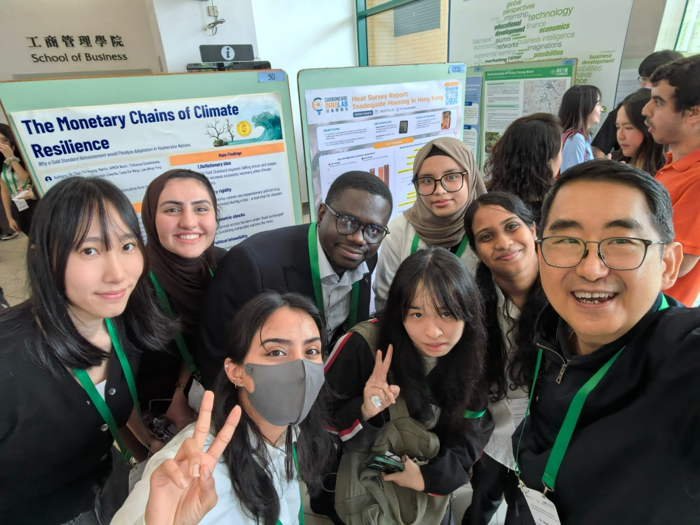
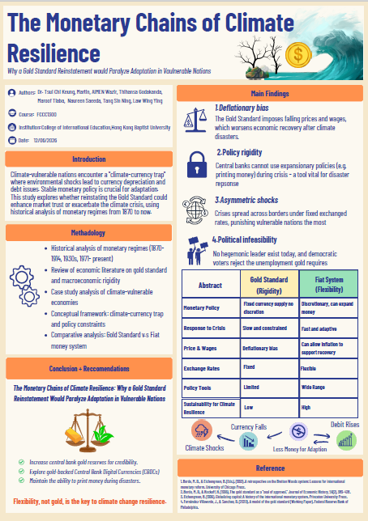
Appiah Kubi, MD, PhD. (Lecturer, Division of Nursing Education, SCE, HKBU) highly appreciated the work of team A050 on the Monetary Chains of Climate Resilience.
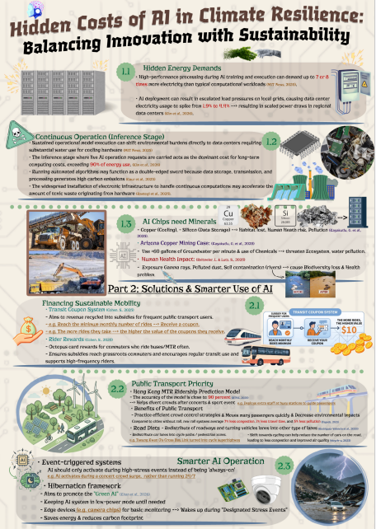
Team A051 shared their research results with Dr. Sam Lau (Director of the Research Management Office and Person-in-Charge of the Research Centre for Environment and Human Health at HKBU SCE) and Mr. Zheng Rong (PhD. student of HKBU, Centre for China Urban and Regional Studies). Both guests highly praised the students for their strong motivation and active presentation during the symposium.