





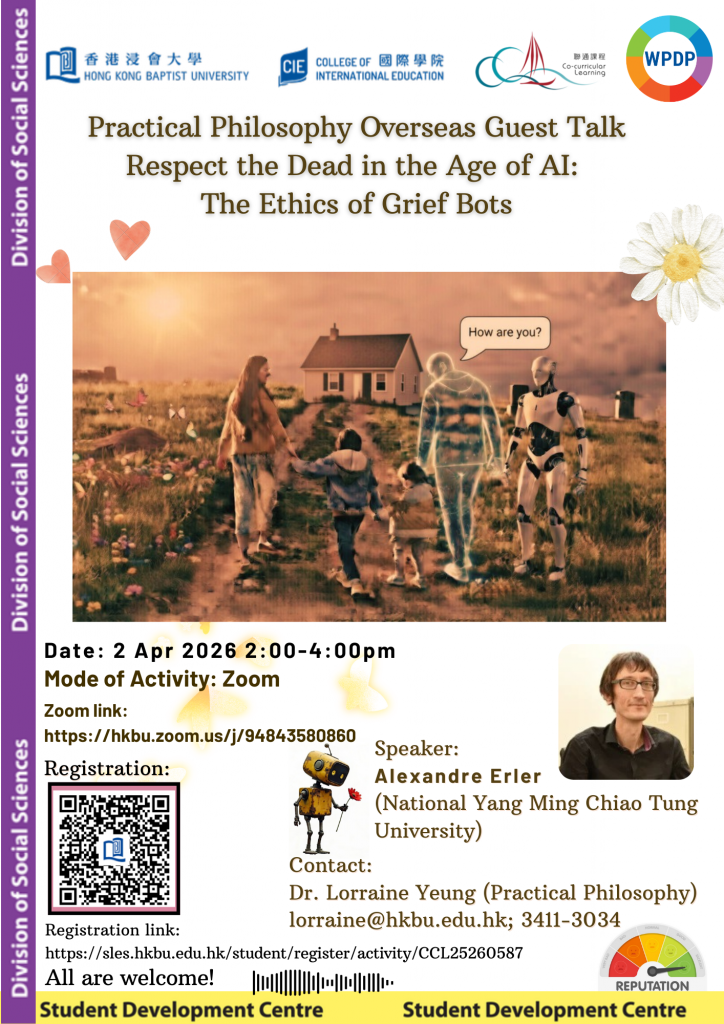
如果您的摯愛之人離世,您是否願意利用其個人資料創建一個人工智能聊天機器人,讓你可以隨時尋求安慰?這樣做是否有倫理問題?CIE 實踐哲學團隊邀請到海外演講嘉賓Professor Alexandre Erler (碰巧在清明節前夕) 與我們探討 Grief bots (哀悼機器人) 的倫理問題。有修讀Technology and the Future of Humanity的實踐哲學同學選擇撰文回應Prof. Erler的講課和即時討論環節為作業。他們樂意在此刊出其文章選節,與師弟妹分享他們的學習成果,並獲取Professor Erler的評論*。
*We would like to thank Prof. Erler for his insightful comments to the students’ responses. 感謝Prof. Erler對學生回應提供評論。
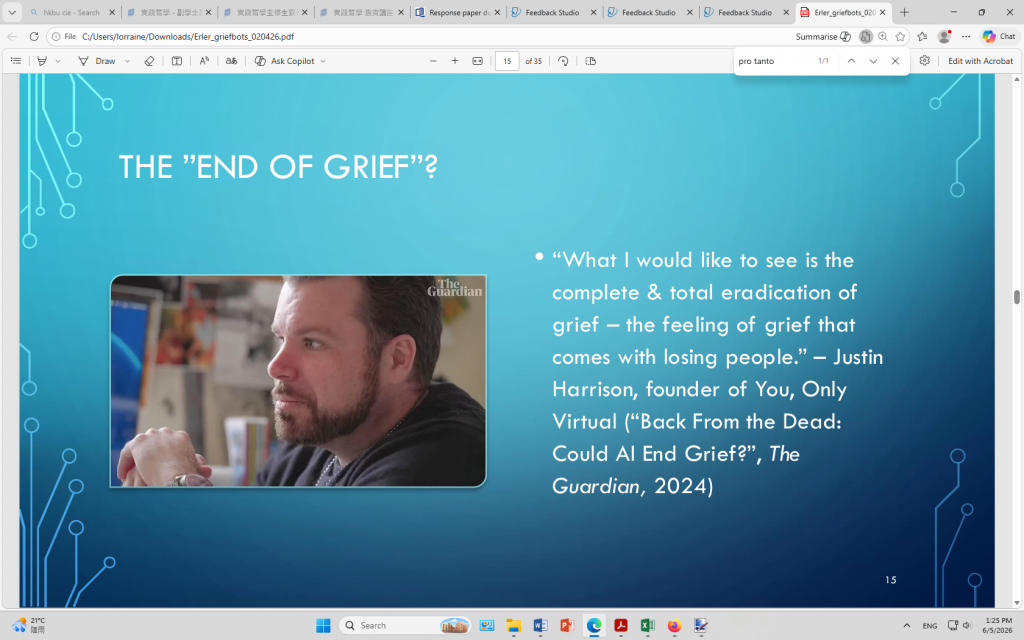
The Founder of “You, Only Virtual” [a company offering grief bots], claims that the technology aims to eradicate grief. Prof. Erler refutes it by stating that grief is a process that helps people learn how to cope with their lives without the deceased. But [I think] Harrison might ask, why do we need to learn that? What if the bereaved just relied on the grief bots throughout? My response is that Harrsion’s statement presupposes that grief bad and needs to be eliminated, but there is a lot of evidence showing that people would live an even better life after experiencing the grieving process. For example, Oltjenbruns (1991) [1] conducted a study to investigate the mental influence of the grieving process. 93 teenagers who lost their loved one were recruited in this study as subjects. 74% of them have a deeper appreciation of life—they take an active role in discovering the new meaning in life without the deceased, and 53% of them developed emotional strength, which helps them face other loss in the future more calmly (including their own death).
[…] The grieving process can help to train our ‘mental immune system’. Analogically, the use of grief bots is similar to taking antibiotics unnecessarily. Our body might gradually lose the “resilience” in resisting bacteria. Using Albert Borgmann’s terms, learning to seek a new meaning in life through grieving is an “ennobling burden” […] but the grief bot seems to liberate the bereaved from it to a [possibly] more impoverished life. (O. Cheung)
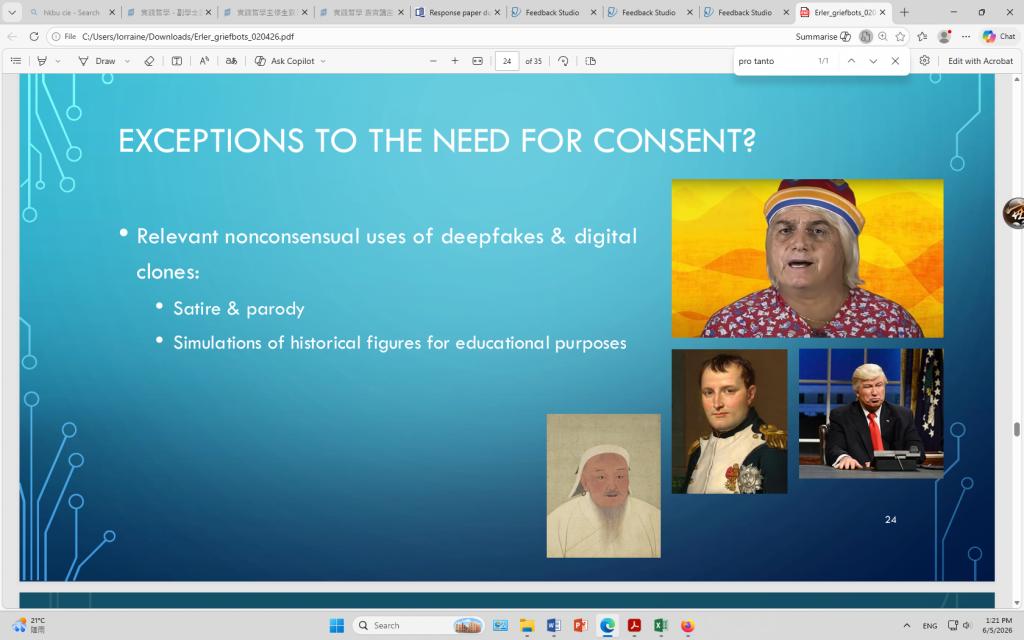
Dr. Erler discusses the issue of consent by applying Adrienne de Ruiter’s argument on deepfakes, […] which defends a “Right to Digital Self-Representation”: one should have the right to reject one’s digital likeness to be used when he would object to the way in which one is represented digitally. Accordingly, one should have the veto right on being made into a grief bots when one does not want to be misinterpreted. Yet, Dr. Erler questions whether this argument would be too restrictive. He illustrates by using the exceptions of satire and parody of public figures made by deepfake technology [, which are deemed acceptable]. (Image 3)
I would like to defend that we should not […] neglect the consent of the deceased. Buddhist ethics empathizes that one should not be trapped in an egocentric view that prioritizes oneself among others, for it will bring more delusional desires [and hinder] one from reaching a wholesome state. A motivation of making grief bots is the desire that we will never be separated with our love ones, or to escape the grief which we believe we are unable to overcome. However, death is a natural process that we go through with or without external intervention. Grief bots create the delusion that we can continue to interact with a person who no longer exists and reject the natural process of departure. It would be even worse if we believe that the deceased’s consent could be outweighed by the sensory benefits we gain — we believe that our emotional needs override the deceased’s wish not to be made into an AI model. We adopt an egocentric approach in which we sacrifice others rather than getting rid of our delusion, and we would then lose the chance of nurturing compassion to others. (C. Yip)
Prof. Erler introduced the terms pro-tanto wrong. “Pro-tanto wrong” means an action is wrong “to its extent’ but not necessarily “just wrong” or “all-things-considered” wrong. […] Borgmann’s Device Paradigm argues that devices alter our way of taking up with life and the world. If the users turn to grief bots mainly for psychological comfort […], the real deceased person may eventually matter less, when the users’ view on relationships gradually focus more on their own feelings resulted from interacting with the simulation. […] The real relationship is no longer valued for the irreplaceable persons involved, but more for the emotional, comforting effect provided. […]
In the Q&A section, some classmates suggested that grief bots should be treated like fictional characters and that there is no difference between engaging with a grief bots and becoming emotionally invested in a fictional figure. I do not agree. Fictional characters are usually approached as fake from the start, but grief bots are not. For a case of stillborn baby grief bot, it still risks developing an intense and obsessive attachment. [Yet] the difference is not absolute: the over-attachment problem also occurs with fictional characters [consider the phenomenon of gamers attached to the digital pet Tamagotchi in the 90’s]. No matter what, taking grief bots like fictional characters still encourages a form of excessive attachment. […] All things considered, I argue that the use of Grief bots is not merely pro-tanto wrong but morally just wrong in most cases. (W. Y. Cheng)
[1] Oltjenbruns, K. A. (1991). Positive Outcomes of Adolescents’ Experience with Grief. Journal of Adolescent Research, 6(1), 43-53.
